
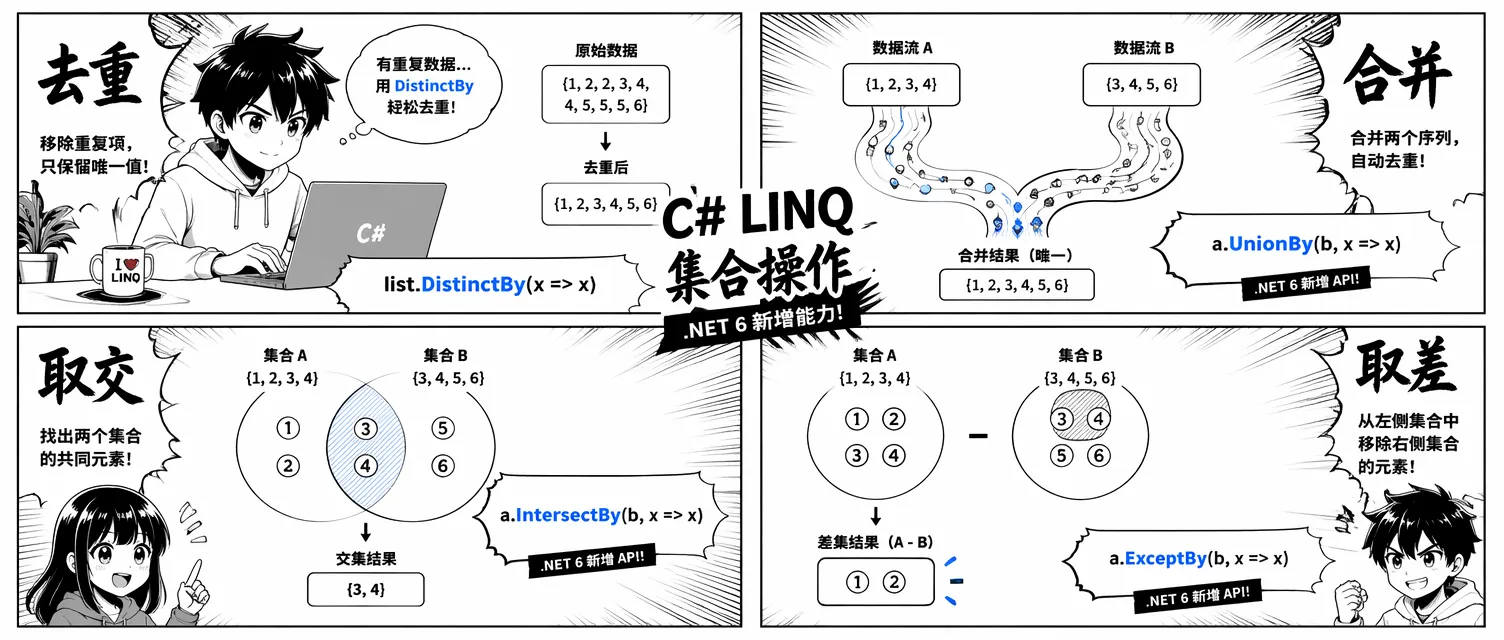
集合去重、交集、差集是日常编程里最常见的需求之一。LINQ 从 .NET Framework 3.5 起就提供了 Distinct、Union、Intersect、Except 四个操作符。.NET 6 在此基础上为每个操作符都加了 By 后缀变体,接受一个 key selector,从根本上消除了大量 IEqualityComparer 的手写需求。
这篇文章把这八个方法放在一起,用真实业务场景的模型举例,帮你看清楚每个操作符做什么、新旧写法有什么区别、以及几个容易踩坑的细节。
领域模型
后面的例子都基于这三个简单 record:
namespace DevLeader.LinqSetOperations;

public record Product(int Id, string Name, string Category, decimal Price);
public record Tag(string Value);
public record Employee(int Id, string Name, string Department, string Email);
record 天然具有结构相等语义,所以在集合操作中不需要额外的 comparer。
Distinct:去重
Distinct() 返回序列中每个不重复的元素。对于值类型和 record,直接可用:
int[] scores = [90, 85, 90, 72, 85, 100];
IEnumerable<int> unique = scores.Distinct(); // 90, 85, 72, 100
对于没有结构相等的引用类型,必须传 IEqualityComparer<T>:
public sealed class ProductNameComparer : IEqualityComparer<Product>
{
    public bool Equals(Product? x, Product? y)
        => string.Equals(x?.Name, y?.Name, StringComparison.OrdinalIgnoreCase);

    public int GetHashCode(Product obj)
        => StringComparer.OrdinalIgnoreCase.GetHashCode(obj.Name);
}

IEnumerable<Product> uniqueByName = catalog.Distinct(new ProductNameComparer());
每次都写一个 IEqualityComparer 很繁琐,这正是 DistinctBy 存在的原因。
DistinctBy(.NET 6):按 key 去重
DistinctBy(keySelector) 保留每个 key 第一次出现的元素,后续重复的直接丢弃,不需要 comparer:
// .NET 6 之前 — GroupBy 变通写法
IEnumerable<Product> uniqueOld = catalog
    .GroupBy(p => p.Name.ToUpperInvariant())
    .Select(g => g.First());

// .NET 6 — 简洁直接
IEnumerable<Product> uniqueNew = catalog.DistinctBy(p => p.Name);

// 每类别保留第一个产品
IEnumerable<Product> onePerCategory = catalog.DistinctBy(p => p.Category);
“第一个元素胜出”与原始序列顺序一致。如果需要每组里的特定元素(比如最便宜的),用 GroupBy 加结果选择器更合适。
复合 key
复合 key 用匿名类型,和 GroupBy、Join 的用法一样:
// 按 (Department, Name) 去重 — 处理调岗和同名的情况
IEnumerable<Employee> uniqueDeptName = employees
    .DistinctBy(e => new { e.Department, e.Name });
匿名类型自带结构相等,两个字段都会参与比较。
Union 和 UnionBy:合并序列
Union 合并两个序列并去重,相当于 SQL 的 UNION(不是 UNION ALL):
IEnumerable<Tag> webTags    = [new("csharp"), new("dotnet"), new("blazor")];
IEnumerable<Tag> mobileTags = [new("csharp"), new("maui"), new("mobile")];

// record 有结构相等,"csharp" 只出现一次
IEnumerable<Tag> allTags = webTags.Union(mobileTags);
// 结果:csharp, dotnet, blazor, maui, mobile对于没有结构相等的引用类型,.NET 6 的 UnionBy 更简洁:
// .NET 6 之前
IEnumerable<Product> combinedOld = storeA
    .Concat(storeB)
    .GroupBy(p => p.Id)
    .Select(g => g.First());

// .NET 6
IEnumerable<Product> combinedNew = storeA.UnionBy(storeB, p => p.Id);注意:当两个序列都包含相同 key 的元素时,UnionBy 保留左序列的那个元素。如果两侧在非 key 字段上有差异,左序列的数据会覆盖右侧。
Intersect 和 IntersectBy:取交集
Intersect 返回同时存在于两个序列中的元素:
IEnumerable<Tag> requiredSkills  = [new("csharp"), new("sql"), new("azure")];
IEnumerable<Tag> candidateSkills = [new("csharp"), new("python"), new("azure"), new("docker")];

IEnumerable<Tag> matchedSkills = requiredSkills.Intersect(candidateSkills);
// 结果:csharp, azureIntersectBy(.NET 6)对 key 做交集:
// .NET 6 之前 — 先建 HashSet 再过滤
HashSet<int> teamBIds = teamB.Select(e => e.Id).ToHashSet();
IEnumerable<Employee> sharedOld = teamA.Where(e => teamBIds.Contains(e.Id));

// .NET 6
IEnumerable<Employee> sharedNew = teamA.IntersectBy(teamB.Select(e => e.Id), e => e.Id);容易混淆的地方:IntersectBy 的第二个参数不是”内序列的 key selector”,而是内序列已经投影出来的 key 值集合,所以要写 teamB.Select(e => e.Id) 而不是直接传 teamB。第一个 key selector(e => e.Id)是对外序列做投影,用来和第二个参数里的 key 值对比。
实际场景——找出同时在促销目录和主目录中的产品:
IEnumerable<Product> eligiblePromo =
    promoProducts.IntersectBy(mainCatalog.Select(p => p.Id), p => p.Id);
Except 和 ExceptBy:取差集
Except 返回第一个序列中不在第二个序列里的元素(集合差):
IEnumerable<Tag> allFeatureTags  = GetAllFeatureTags();
IEnumerable<Tag> deprecatedTags  = GetDeprecatedTags();

IEnumerable<Tag> activeTags = allFeatureTags.Except(deprecatedTags);ExceptBy(.NET 6)用 key 做差集:
// .NET 6 之前
HashSet<int> terminatedIds = terminatedEmployees.Select(e => e.Id).ToHashSet();
IEnumerable<Employee> activeOld = allEmployees.Where(e => !terminatedIds.Contains(e.Id));

// .NET 6
IEnumerable<Employee> activeNew =
    allEmployees.ExceptBy(terminatedEmployees.Select(e => e.Id), e => e.Id);
找出主目录中还没有参与任何促销的产品:
IEnumerable<Product> unpromotedProducts =
    mainCatalog.ExceptBy(promoProducts.Select(p => p.Id), p => p.Id);
自定义相等:IEqualityComparer
当默认相等不够用时(比如大小写不敏感的 Tag 比较),所有集合操作符都支持传入 IEqualityComparer<T>:
public sealed class CaseInsensitiveTagComparer : IEqualityComparer<Tag>
{
    public static readonly CaseInsensitiveTagComparer Instance = new();

    public bool Equals(Tag? x, Tag? y)
        => string.Equals(x?.Value, y?.Value, StringComparison.OrdinalIgnoreCase);

    public int GetHashCode(Tag obj)
        => StringComparer.OrdinalIgnoreCase.GetHashCode(obj.Value);
}

IEnumerable<Tag> sourceTags = [new("CSharp"), new("DOTNET")];
IEnumerable<Tag> filterTags = [new("csharp"), new("blazor")];

// "CSharp" 被过滤掉,因为不区分大小写匹配到了 "csharp"
IEnumerable<Tag> remaining = sourceTags.Except(filterTags, CaseInsensitiveTagComparer.Instance);
// 结果:DOTNET
comparer 上的单例模式(Instance)避免在高频路径上重复分配。
值类型与引用类型的行为对照
| 类型 | 默认相等 | 集合操作表现 |
|---|---|---|
int、string、bool | 结构相等 | 无需 comparer |
record(C# 9+) | 结构相等(自动生成) | 无需 comparer |
struct(自定义) | 默认结构相等 | 通常正确 |
class(无重写) | 引用相等 | 需要 IEqualityComparer 或 *By |
class(重写了 Equals/GetHashCode) | 自定义结构相等 | 无需 comparer |
如果你在设计供 LINQ 集合操作使用的领域类型,优先选 record——它在大多数场景下都能直接用,不需要写 comparer 样板代码。
组合使用:增量变更检测
集合操作符可以自由组合。一个经典的”快照差量”模式:
IEnumerable<Product> catalogPrevious = GetPreviousCatalog();
IEnumerable<Product> catalogCurrent  = GetCurrentCatalog();

// 新增的产品
IEnumerable<Product> added =
    catalogCurrent.ExceptBy(catalogPrevious.Select(p => p.Id), p => p.Id);

// 移除的产品
IEnumerable<Product> removed =
    catalogPrevious.ExceptBy(catalogCurrent.Select(p => p.Id), p => p.Id);

// 两个快照都有的产品
IEnumerable<Product> unchanged =
    catalogCurrent.IntersectBy(catalogPrevious.Select(p => p.Id), p => p.Id);
这个 delta 模式在同步流程、变更检测管道和增量数据处理中很常见。
几个常见问题
Distinct 和 DistinctBy 的区别?
Distinct() 按元素本身的相等性去重;DistinctBy(keySelector) 按投影 key 去重,保留每个 key 第一次出现的元素,无需 comparer。
Union 会对单个序列内部也去重吗?
是的。Union 对合并后的整体去重,包括每个源序列内部的重复项。如果只想拼接不去重,用 Concat。
IntersectBy 和 Where + HashSet 哪个性能更好?
性能相当——IntersectBy 内部也是建 HashSet。区别在于:Where + HashSet 模式可以在多个操作中复用同一个 HashSet;IntersectBy 更声明式,意图更清晰。
集合操作是延迟执行的吗?
是的,Distinct、DistinctBy、Union、UnionBy、Intersect、IntersectBy、Except、ExceptBy 都是延迟执行。内部 HashSet 在元素被 yield 时才按需构建。
能对不同类型的序列做集合操作吗?
两个序列的元素类型 T 必须一致。如果有 IEnumerable<Product> 和 IEnumerable<DiscountedProduct>,需要先投影到公共类型。这也是 *By 变体的优势——IntersectBy 可以用共同的 Id 字段关联两个不同类型的序列,不需要类型转换。
小结
LINQ 的八个集合操作方法覆盖了日常的去重、合并、取交集、取差集需求:
Distinct/DistinctBy:去重,.NET 6+ 优先用DistinctBy避免写 comparerUnion/UnionBy:合并并去重,key 冲突时左序列优先Intersect/IntersectBy:取两个序列的公共部分Except/ExceptBy:取左序列中不在右序列里的部分- 所有操作符都支持延迟执行,也都接受可选的
IEqualityComparer<T>
设计新领域类型时优先选 record,LINQ 集合操作里就不需要 comparer 了。需要精细控制相等语义时,再引入 IEqualityComparer 单例。